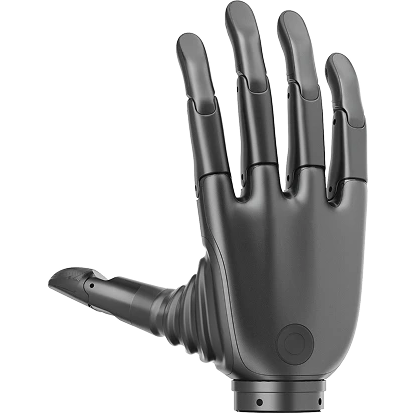
Python API usage guidelines
Import SDK 2.x Python bindings from bc_revo3_sdk.main_mod and perform domain operations through Manager and Hand. Use the official API specification for exact types and signatures.
Logging initialization
sdk.init_logging(level=sdk.LogLevel.Info, enable_file_logging=True) sets the SDK log level. When file output is enabled, the SDK installs its own Python logging.FileHandler and writes to logs/revo3_<timestamp>.log. Repeated calls replace that SDK handler without removing handlers configured by the application. Pass enable_file_logging=False when only integration with the existing Python logging configuration is required.
Lifecycle and cleanup
- Await asynchronous methods inside an
asyncioevent loop. - Use
async with, or closeHandandManagerin atry/finallyblock. - Subscriptions and
ServoSessionobjects have independent lifecycles and must be closed on success, failure, and cancellation paths. - After a disconnect, close the old objects and reconnect through
Manager. Do not reuse old motion handles, subscriptions, or Servo sessions. - Await cleanup before process exit so serial ports, CAN devices, and background tasks are released.
See quickstart.py for the connection and cleanup structure, and multi_hand.py for multi-device ownership.
Async operations, timeouts, and cancellation
- A returned
MotionHandledoes not mean physical motion is complete.awaitits result to obtain the final status, and always use a bounded timeout when waiting. - A timeout does not prove that a command was not applied. If
operation_effectisIndeterminate, read State before deciding whether a retry is safe. - Task cancellation must still run
finallycleanup. Close the subscription or session instead of only cancelling its outerasyncio.Task. - Use
ServoSessionfor high-rate targets; do not emulate streaming by repeatedly invoking discrete motion methods. - Define the Servo send cadence and command timeout explicitly. Application scheduling is not a fixed bus- or firmware-rate guarantee.
See trajectory_control.py for bounded motion waiting and streaming_control.py for continuous control.
Errors and recovery
- Catch
SdkErrorand usecode,operation_effect,recovery_requirement, andretryable; do not branch only on message text. - Before retrying, determine whether the operation may already have taken effect. Read State and Health when the device outcome is uncertain.
- After reconnecting, repeat device-info, joint-layout, and health preflight checks before resuming motion.
- Do not hide persistent port ownership, resource leaks, or hardware faults behind unbounded retries.
See errors and recovery and connection, discovery, and multiple devices.
Data, concurrency, and control ownership
- Pass joint arrays as sequences and validate their lengths against the active
JointLayout. Refresh the layout after reconnecting or changing devices. - Give one application component explicit ownership of motion control for each hand. Do not let discrete motion, Servo, teaching, or replay compete concurrently.
- Subscriptions pull periodic data but do not retain history. Follow the bounded-queue and drop-policy guidance to isolate data classes, cap capacity, and expose drop metrics.
- Keep blocking work out of subscription processing so event-loop cleanup, timeouts, and control tasks remain responsive.
See subscriptions.py for subscription handling. Start new integrations with the quickstart.