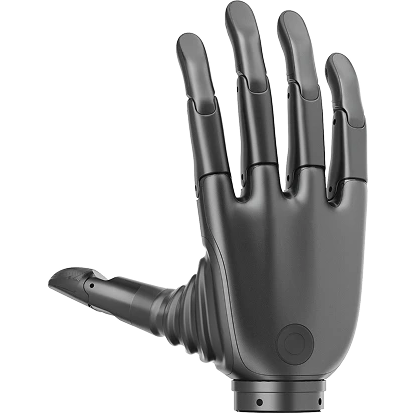
BrainCo Revo 3 Industrial Dexterous Hand FAQ
Which communication protocols does the Revo 3 support?
Revo 3 supports Modbus RTU over RS485 and CAN FD. Revo 3 SDK v2.x uses both protocols through the Manager / Hand interfaces. EtherCAT uses a standalone Linux IgH C++ integration and does not use the Revo 3 SDK v2.x Manager / Hand interfaces.
What power supply is recommended for the 21-motor Revo 3?
Revo 3 accepts an input voltage range of 16–85 V. Use a stable 24 V industrial DC power supply rated for more than 100 W. Heavy loads or simultaneous multi-finger motion can produce high transient current; insufficient power capacity may cause voltage drops or controller resets.
How are real-time control rate and latency determined in Revo 3 SDK v2.x?
For continuous real-time control, create a Servo session with hand.motion.open_servo(). The application owns the send period, command timeout, and session shutdown. The default RS485 baud rate is 5 Mbps, but actual control rate and end-to-end latency also depend on host scheduling, the communication adapter, bus load, device configuration, and firmware. The SDK does not guarantee a fixed rate across all environments.
Telemetry subscriptions read device state; their subscription rate is not the Servo command rate. Measure cycle time, jitter, timeouts, and packet loss on the target hardware and actual bus topology before deployment. See State, subscriptions, and real-time control.
Does the Revo 3 support automatic calibration?
Yes. Revo 3 SDK v2.x exposes device calibration, calibration current, current-position zeroing, zero-point access, and restoration of finger defaults through hand.calibration. Power-on calibration behavior can be read or configured through hand.config.
Whether calibration runs automatically after power-on depends on device configuration and firmware; applications must not assume that every device calibrates on every startup. Calibration and zero-point operations change the motion reference. Confirm the target device, mechanical clearance, and load conditions before execution, then read back the zero point, State, and Health. See Configuration, calibration, and maintenance.
What units are used for position, velocity, and current control?
Revo 3 SDK v2.x public interfaces use these physical units:
- Position: degree
- Velocity: rpm
- Current: mA
The SDK applies register wire scaling. Do not apply the protocol scaling again in API calls.
How do I confirm the hand model and configuration?
After connecting, read the serial number, model, side, and hardware revision from hand.device_info, and read the layout ID, version, and joint count from hand.joint_layout. Validate control-target array lengths against JointLayout and obtain limits from the device configuration.
The SN uniquely identifies the device for tracking and support; do not infer the model, tactile configuration, or joint layout solely from SN characters. Override the model only when a BOM or validation record confirms it. Otherwise, contact technical support. See Manager, Hand, and device metadata.
Contact & Support
📞 Contact for Support & Purchase
For technical, integration, customization, or bulk-purchase questions, contact the BrainCo Dexterous Hand Technical Support Team, or submit a support ticket through the page Help entry.